Youth detention is a crucial issue throughout Europe, as stakeholders pursue more humane, effective, and community-focused ways to support young people facing deprivation of liberty.
In Austria, research initiated by Salzburg Children’s and Youth Advocacy sparked a collaboration with the NGO Richtungswechsel. A joint visit to the small-scale facility of Seehaus in Germany, together with Salzburg’s prison director, Colonel Knebel, further fuelled interest in practical alternatives for Austria’s youth detention system.
In May 2025, the first Youth Custody Conference took place in Salzburg. Richtungswechsel and Salzburg Children’s and Youth Advocacy initiated a meaningful dialogue about what a child-centred, rights-based, and progressive model of youth detention could look like in Austria.
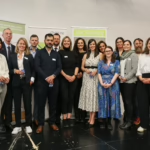
Over 120 experts from 16 countries gathered to share insights and examine the feasibility of small-scale custodial alternatives. The conference showcased inspiring international practices and explored how such approaches might be adapted to Austria’s legal, political, and social contexts.
Institutional perspectives: Austria and beyond
The conference opened with insights from Katharina Dürr of the General Directorate for the Austrian Prison System. Dürr outlined the current state of Austria’s youth detention framework, emphasising challenges such as overcrowding, limited family proximity, and restricted access to support services within existing institutions. Her presentation highlighted the urgent need for reform to support young people in detention better and facilitate their (re)integration.
Next, Karel Dvořák, the Czech Republic’s Deputy Minister of Justice, described ongoing efforts in Czechia to move away from large-scale incarceration towards smaller, target group–oriented facilities more closely embedded in local communities. He showcased promising examples, such as an open prison for men and a probation house supporting reintegration, which already reflect key approaches to incarceration like dynamic security and trust-based relationships.
He emphasised the Czech Republic’s collaboration with the RESCALED network, notably through RUBIKON, the Czech member of RESCALED, and underlined the government’s intention to develop a context-specific detention house facility. Dvořák concluded with a clear commitment to realising the EU Council’s call for small-scale detention, stating:
“We have a common task to fulfil the conclusion of small-scale detention adopted by the EU Council last year.”
His contribution reflected both a grounded awareness of current systemic challenges and a forward-looking dedication to transforming imprisonment into a more humane, reintegrative, and community-connected system.
Setting a new vision
Colonel Dipl. – Päd. Dietmar Knebel from the Austrian Ministry of Justice officially launched the conference, emphasising political will and the need for a justice system that prioritises young people’s development and societal safety.
“What these young individuals truly need is structure within an environment that fits their specific needs surrounded by peers, personal mentors, and small, intensively supported groups.“
Building on this foundation, Noa Shoshan, Knowledge Manager at RESCALED Europe, presented the movement’s core principles and vision: a paradigm shift from large prison institutions toward small-scale detention houses embedded in and supported by local communities.
She described these houses as accommodating a maximum of 30 residents, working closely with local services, schools, neighbours, and civil society organisations. She emphasised the need for a collective effort. RESCALED’s work goes beyond policy; it seeks to shift societal narratives around incarceration through knowledge sharing, raising awareness, and the cross-national exchange of best practices.
Importantly, Shoshan stressed that there is no one-size-fits-all model:
“There is not one perfect detention house model – in practice, it materialises in various ways because it depends on a national context, it depends on the legal frameworks, it depends on the community where it is located, and it depends on the local services.”
Therefore, implementation must be tailored to context and involve early community engagement to address scepticism and promote shared responsibility.
Overall, detention houses offer a more sustainable and effective approach to incarceration. However, they must be part of a broader ecosystem prioritising integration, differentiation, and community-based care.
Political momentum is increasing: all 27 EU Ministers of Justice recently issued a joint statement endorsing small-scale detention, and the UN Human Rights Council emphasised these models in a resolution on social (re)integration.
Model from practice: Estonia and Germany
Stanislav Solodov from Estonia’s Ministry of Justice outlined two initiatives to support young people’s reintegration. These efforts reflect Estonia’s broader strategy of combining state-led policy with NGO-driven practices to promote long-term change.
The monitoring programme connects young people aged 14 to 20 with trained mentors six months before their release. Building trust is a key aspect of supporting personal growth, helping to shift values and attitudes, and ultimately enabling sustainable behaviour change. The second initiative is the halfway house, operated in partnership with the Village of Hope. Up to 20 young people live in a structured, family-like environment in these small-scale residential settings.
Solodov emphasised that a minimum of nine months of long-term support is critical for success. Shorter interventions show little effect.
From Germany, Ulrich Weinhold and Irmela Abrell shared insights into the Seehaus e.V. facilities, where adolescents in conflict with the law live in supervised homes together with mentor families. Daily life in Seehaus follows a clear and structured routine, including school attendance, vocational training, shared meals, household responsibilities, sports, and group discussions. This everyday structure is designed to promote responsibility, rhythm, and a sense of community.
Instead of control and punishment, daily life is built on trust, accountability, and positive relationships.
“We don’t focus on what went wrong – we focus on what can go right from here.”
A cornerstone of Seehaus is its commitment to restorative justice. Crime is seen as harm done to human relationships, and change is facilitated through dialogue, accountability, and active involvement of survivors, peers, and the community. Through this approach, Seehaus promotes communal living as a route to reintegration, focused on personal development and constructively resolving conflicts.
Austria’s opportunity to lead change
Throughout the Youth Justice Conference, participants expressed a common belief: youth detention should not merely aim to reduce harm but must actively support young people in growing, restoring relationships, and envisioning a future beyond deprivation of liberty. While some voiced concerns that Austria risks falling behind, others emphasised that the necessary momentum is already present. What is needed now is bold leadership and practical steps forward.
Austria now stands at a pivotal crossroads. Experts, practitioners, and policymakers alike signalled a strong desire for transformation; one that embraces small-scale, human-centred approaches rooted in dignity, participation, and community.
The conference clarified that the necessary foundations are already in place: international inspiration, local expertise, and a wealth of practical models. Yet, the political will and societal vision remain to bring them to life. The examples of RESCALED, Estonia, and Seehaus, along with the voices of the Austrian professionals, highlight what is possible: an approach to detention that restores dignity, supports growth, and aligns justice with social integration.
By initiating a pilot project grounded in these values, Austria has the chance to reform its system and contribute meaningfully to a growing European movement. A system that reimagines detention as a space for support, accountability, hope, and that gives young people a chance.